Showing posts with label cloud services. Show all posts

Thursday, May 17, 2012

Top 10 BYOD and Virtualization Market Insights

Like it or not, some enterprises have already entered a post-PC world -- where their business communication network must accommodate new user-driven choices. These include traditional applications, mobile apps, social apps and operating systems; various server architectures; and an array of mobile devices ranging from smartphones to tablets and other mobility tools. Are you experiencing this phenomenon? If not, you will soon. Moreover, this latest business technology trend has huge ramifications.

Cisco’s Internet Business Solutions Group (IBSG) conducted extensive research and analysis to uncover key insights about BYOD (“bring your own device”) and desktop virtualization trends in U.S. enterprises. The Cisco IBSG Horizons BYOD and Virtualization study surveyed 600 enterprise IT leaders from 18 industries.

The Top 10 Market Insights


Insight 1: Mobility Is Pervasive
  • Seventy-eight percent of U.S. white-collar employees use a mobile device (e.g., laptop, smartphone, or tablet) for work purposes.
  • Respondents indicated that 65 percent of white-collar workers in their organizations require mobile connectivity to do their jobs.
  • Forty-four percent of knowledge workers telecommute at least once per week.
  • Cisco IBSG estimates that telecommuting once a week saves $2,500 per employee annually.

Insight 2: Growth of Mobility Has Impacted IT Profoundly
  • By 2014, the average number of connected devices per knowledge worker will reach 3.3, up from an average of 2.8 in 2012 (18 percent increase).
  • On average, mobility initiatives will consume 20 percent of IT budgets in 2014, compared to 17 percent in 2012.

Insight 3: How Much Longer Will Traditional Funding Models Exist?
  • Sixty-two percent of respondents’ organizations pay for both employees’ devices and their voice/data plans.
  • Seventy-five percent of respondents expect the share of employee-owned devices connected to company networks to increase “somewhat” to “significantly” over the next two years.
  • Forty-one percent of respondents indicated a majority of smartphones connecting to their company network are actually employee-owned.
  • According to Cisco IBSG, employees are willing to invest to improve their work experience. Cisco BYOD employees, for example, pay an average of $600 for their preferred devices.

Insight 4: BYOD Is Here, and It’s Not a Bad Thing
  • Eighty-eight percent of surveyed IT leaders perceive growing technology “consumerization” in the enterprise.
  • Seventy-six percent consider consumerization “somewhat” or “extremely” positive for their companies.

Insight 5: BYOD Delivers Several Benefits to the Enterprise
  • Among respondents, the top two perceived benefits of BYOD were improved employee productivity (more opportunities to collaborate) and greater job satisfaction.
  • The benefits of BYOD vary based on an employee’s role and work requirements. Cisco IBSG estimates that the annual benefits from BYOD range from $300 to $1,300, depending on the employee’s job role.

Insight 6: BYOD Does Bring Its Share of Challenges
  • Respondents cited the top challenges of BYOD as (1) ensuring security/privacy of company data and (2) providing IT support for multiple mobile platforms.
  • Thirty-six percent of respondents said that their organizations’ IT departments provide full support for employee-owned devices connected to the company network, with an additional 48 percent indicating that their IT departments support selected devices. Eleven percent said that their companies tolerate employee-owned devices but don’t support them, and just 5 percent said their organizations forbid employee-owned devices.
  • According to Cisco IBSG, 86 percent of BYOD costs are non-hardware-related, highlighting the importance of choosing the right governance and support models to control these costs.

Insight 7: Employees Want To Control Their Work Experience
  • Employees are turning to BYOD because they want more control of their work experience, thus improving productivity and job satisfaction.
  • Forty percent of respondents cited “device choice” as their top BYOD priority (the ability to use their favorite device — anywhere).
  • Respondents’ second BYOD priority is the desire to perform personal activities at work, and work activities during personal time.
  • Employees also want to bring their own applications to work. Sixty-nine percent of respondents said that unapproved applications — especially social networks, cloud-based email, and instant messaging — are somewhat to much more prevalent today than two years ago.

Insight 8: Desktop Virtualization Is on the Rise
  • Desktop virtualization enables employees to enjoy a similar experience across a broad range of devices — from desktop and laptop PCs to smartphones and tablets. This capability is alternately referred to as virtual desktop infrastructure (VDI), hosted virtual desktop (HVD), desktop as a service (DaaS), and server-based computing.
  • Eighty percent of respondents indicated that they are “very aware” of desktop virtualization, and 18 percent said they are “somewhat aware.”
  • Sixty-eight percent of respondents agreed that a majority of knowledge worker roles are suitable for desktop virtualization.
  • Fifty percent noted that their organization is in the process of implementing a desktop virtualization strategy.

Insight 9: Desktop Virtualization Also Poses Challenges
  • While 70 percent of IT leaders recognize that half or more of their organization’s employees could benefit from desktop virtualization, they also expressed some concerns.
  • Respondents’ top concern (33 percent) was data protection — ensuring that only the right people have access to sensitive company and customer data. The No. 2 concern was business continuity — the ability to continue operations under adverse conditions, such as interruptions due to natural or man-made hazards.

Insight 10: Desktop Virtualization Will Impact Much of the Business
  • Desktop virtualization is already making its mark and will continue to have a significant impact on enterprise business. Survey respondents noted the following as the three areas that will benefit most from desktop virtualization: (1) business continuity, (2) employee productivity, and (3) IT costs.
  • Among devices, respondents listed their top desktop virtualization priorities as laptops (81 percent), desktops (76 percent), smartphones (64 percent), and tablets (60 percent).
  • Survey respondents stated that the top four job roles being targeted for desktop virtualization are (1) field-/customer-facing employees, (2) employees who handle sensitive company data, (3) employees who work from home frequently, and (4) executives.
  • Desktop virtualization and BYOD are changing the way applications are provisioned to employees. For example, 35 percent of respondents said that employees can download only pre-approved applications from the company app store, while 23 percent indicated that both approved and nonstandard applications are available from the company app store.

Thursday, May 10, 2012

How CIOs Migrate their IT Applications to the Cloud

As the role of cloud computing is growing around the globe, many CIOs and other senior IT decision makers are facing challenges with their existing network infrastructure -- to support the migration of their business applications to the cloud. A new international study by Cisco Systems revealed the ongoing challenges associated with public or private cloud deployments.

These latest research findings provide insight into the current state of cloud service adoption and the chasm between IT expectations and network realities. The survey also examines the experiences of IT professionals regarding the level of difficulty and time required to update their networks and migrate their applications to the cloud.

The 2012 Cisco Global Cloud Networking Survey addresses the applications that are most critical for businesses to move to a cloud services delivery model, as well as the network challenges and potential disruptions and road blocks they are facing during this process. The report also takes a closer look at the typical length of these cloud migrations, and how confident IT professionals are in the ability of their own network deployments to securely deliver an optimal cloud application experience.

Among its findings, the study reveals that updating the network is one of the top focus areas for cloud migration. In order to successfully move more applications to the cloud, the majority of respondents cited a cloud-ready network (37 percent) as the biggest infrastructure element required for further cloud deployments, ahead of a virtualized data center (28 percent) or a service-level agreement from a managed cloud service provider (21 percent).

This data expands on the Cisco Global Cloud Index, which predicts that more than 50 percent of computing workloads in data centers will be cloud-based by 2014, and that global cloud traffic will grow over 12 times by 2015, to 1.6 zettabytes per year – the equivalent of over four days of business-class video for every person on Earth.


Key findings from the global market study include:

Cloud Deployments in Perspective
  • Almost two in five (39 percent) of those surveyed said they dread network challenges associated with private or public cloud deployments so much that they would rather get a root canal, dig a ditch, or do their own taxes.
  • At the same time, nearly three quarters (73 percent) feel they are confident with enough information to begin their private or public cloud deployments. However, the remainder (27 percent) feels they have more knowledge about how to play Angry Birds than the steps needed to migrate their company's network and applications to the cloud.
  • In a clear sign that many IT organizations are still considering and planning cloud migrations, nearly one quarter (24 percent) of IT decision makers said that over the next six months, they are more likely to see a UFO, a unicorn or a ghost before they see their company's cloud migration starting and finishing.
  • Without proper processes and planning, more than one quarter (31 percent) said they could train for a marathon in a shorter period of time than it would take to migrate their company's applications to the cloud.
  • A majority (76 percent) predict their cloud applications are likely to be breached, yet only one quarter (24 percent) are confident to the point in which they believe the odds are better for them to be struck by lightning than have their cloud applications breached by an unwanted third party.

Cloud Deployments Expected to Increase Significantly by the end of 2012

  • Presently, only 5 percent of IT decision makers have been able to migrate at least half of their total applications to the cloud. By the end of 2012, that number is expected to significantly rise, as one in five (20 percent) will have deployed over half of their total applications to the cloud.

Most Critical Infrastructure for Cloud Deployments

  • In order to successfully move more applications to the cloud, the majority of respondents cited a cloud-ready network (37 percent) as the biggest infrastructure element required for further cloud deployments, ahead of a virtualized data center (28 percent) or a service-level agreement from a cloud service provider (21 percent).

Top Infrastructure Roadblocks to Cloud Migration

  • During the cloud migration process, data protection security (72 percent) was cited as the top network challenge or roadblock responsible for preventing a successful implementation of cloud services, followed by availability/reliability of cloud applications (67 percent), device-based security (66 percent), visibility and control of applications across the WAN (60 percent) and overall application performance (60 percent).

Top Choice of Application for Cloud Migration

  • If given the choice of only being able to move one application to the cloud, most respondents would choose storage (25 percent), followed by enterprise resource planning (ERP) applications to manage HR, customer relationship management, supply chain management, and project management systems (20 percent). Email (16 percent) and collaboration solutions (15 percent) followed.

Reality Check: Status of Cloud Application Migration

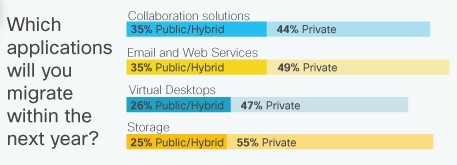
  • When asked which applications have been moved, or are being planning to be moved to public or private clouds in the next year, the majority of IT decision makers cited email and Web services (77 percent), followed by storage (74 percent) and collaboration solutions such as Web conferencing and instant messaging (72 percent).

Monday, May 7, 2012

Cloud-Based Collaboration Services in Asia-Pacific Gov

Government agencies are reportedly one of the primary benefactors of managed cloud services. According to the results from a recent market study by IDC, IT decision-makers across the Asia-Pacific region (excluding Japan) found that 59 percent of public sector respondents are confident in the ability of their internal IT departments to deploy private cloud environments.

However, IDC Government Insights cautions that high levels of private cloud adoption may not bode well for a collaborative and citizen-engaging government and preemptive measures should be taken for collaboration to take place across organizational boundaries. More insights can be found in the IDC report entitled, "Cloud Computing for Government: a View from Asia-Pacific."

Frank Levering, Research Manager for IDC said, "An efficient and productive internal IT department is definitely a good to have in any organization, private or public. However, a department that is highly confident in running its own private cloud environment may run the risk of not reaching out to other internal departments to collaborate on cloud opportunities."

To counter this possibility, IDC recommends that whenever possible, governments should consider cloud-based collaboration services rather than independent private cloud solutions.

Although governments will initially be seeking cloud-based solutions to deliver cost advantages and better manage resources, eventually, cloud implementations need to be about inter-department collaborations and citizen relationship management in order to reap the full benefits of its capabilities to deliver optimal citizen services.

This is particularly important for key initiatives like data classification for security purposes; if agencies do not align their security levels, it would prove to be a massive obstacle for future joint efforts.

A positive sign is that governments across the region are growing to recognize the need for collaboration within the cloud space. There is already a significant installed base of collaborative applications in the cloud and the numbers will grow significantly in the next 12 months.


To optimize the benefits of cloud services, IDC offers recommendations to governments:
  • Evaluate all aspects of cloud computing. Read everything you can get your hands on. Most suppliers will have recognized that the key to their long-term success is their short-term role as an educator. Since security is a big concern, develop security profiles for all suppliers being considered.
  • Service-oriented architecture (SOA) first, then cloud. The right SOA needs to be in place to facilitate a smooth connection to external cloud services. Government agencies needing to build a robust SOA require a plan that tackles the transition in bite-size pieces while solidifying long-term migration to the shared services architecture. Remove the key barriers to cloud computing.
  • Challenges like security concerns and decentralized data storage will be blocking issues until they are acknowledged and appropriately addressed. Many of the more complex scenarios, like customer/citizen relationship management and inter-department collaboration will depend on a government's ability to get the basics right.
  • Know your current environment. An inventory of the current environment should provide a good indication of whether systems contain sensitive data, including taxpayers' personally identifiable information and/or mission-critical data and (legacy) applications. This will provide an excellent start to planning for cloud services adoption.

Monday, April 16, 2012

Five Megatrends are Driving the Personal Cloud Era

If you believe that you've had to learn more about the safe online operation and ongoing management of your PC than you ever wanted to know, then you'll be pleased to discover that there's relief on the horizon. According to the latest market study by Gartner, the reign of the personal computer is coming to an apparent close. By 2014, the personal cloud will replace the personal computer -- and this transition will likely include greater use of media tablets, chromebooks or other similar devices.

Gartner analysts said the personal cloud will become the foundation for a new era that will provide users with an increased level of flexibility with the devices they use for daily activities -- leveraging the strengths of each device, ultimately enabling new levels of user satisfaction and productivity.

However, Garner says that it will require enterprise IT leaders and their staff to fundamentally rethink how they deliver applications and services to their end-users.

Seeking New Fundamental Ways to Achieve Goals

"Major trends in client computing have shifted the market away from a focus on personal computers to a broader device perspective that includes smartphones, tablets and other consumer devices," said Steve Kleynhans, research vice president at Gartner.

He says that emerging cloud computing services will become the glue that connects the various digital devices that people will choose to use during the different aspects of their daily life.

"Many call this era the post-PC era, but it isn't really about being after the PC, but rather about a new style of personal computing that frees individuals to use computing in fundamentally new ways to improve multiple aspects of their work and personal lives," said Kleynhans.

Transition is Defined by a Series of Megatrends

Several driving forces are combining to create this new era. Gartner believes that these "megatrends" have roots that extend back through the past decade, but are aligning in a new way:

1. Consumerization -- Gartner has discussed the consumerization of IT for the better part of a decade, and has seen the impact of it across various aspects of the corporate IT world. However, much of this has simply been a precursor to the major wave that is starting to take hold across all aspects of information technology as several key factors come together:
  • Users are more technologically savvy and have very different expectations of technology.
  • The Internet and social media have empowered and emboldened users.
  • The rise of powerful, affordable mobile devices changes the equation for users.
  • Users have become innovators.
  • Through the democratization of technology, users of all types and status within organizations can now have similar technology available to them.

2. Virtualization -- it has improved flexibility and increased the options for how IT organizations can implement client environments. Virtualization has, to some extent, freed applications from the peculiarities of individual devices, operating systems or even processor architectures. Virtualization provides a way to move the legacy of applications and processes developed in the PC era forward into the new emerging world. This provides low-power devices access to much-greater processing power, thus expanding their utility and increasing the reach of processor-intensive applications.

3. Software App-ification -- When the way that applications are designed, delivered and consumed by users changes, it has a dramatic impact on all other aspects of the market. These changes will have a profound impact on how applications are written and managed in corporate environments. They also raise the prospect of greater cross-platform portability as small user experience (UX) apps are used to adjust a server- or cloud-resident application to the unique characteristics of a specific device or scenario. One application can now be exposed in multiple ways and used in varying situations by the user.

4. The Self-Service Cloud -- The advent of the cloud for servicing individual users opens a whole new level of opportunity. Every user can now have a scalable and nearly infinite set of resources available for whatever they need to do. The impacts for IT infrastructures are stunning, but when this is applied to the individual, there are some specific benefits that emerge. Users' digital activities are far more self-directed than ever before. Users demand to make their own choices about applications, services and content, selecting from a nearly limitless collection on the Internet. This encourages a culture of self-service that users expect in all aspects of their digital experience. Users can now store their virtual workspace or digital personality online.

5. The Mobility Shift -- Today, mobile devices combined with the cloud can fulfill most computing tasks, and any tradeoffs are outweighed in the minds of the user by the convenience and flexibility provided by the mobile devices. The emergence of more-natural user interface experiences is making mobility practical. Touch- and gesture-based user experiences, coupled with speech and contextual awareness, are enabling rich interaction with devices and a much greater level of freedom. At any point in time, and depending on the scenario, any given device will take on the role of the user's primary device -- the one at the center of the user's constellation of devices.